 In my last blog post, Brainspotting Therapy: What It Is and How It Helps, I shared an overview of Brainspotting as a therapeutic method that can help you process emotions, body sensations, memories, and “stuck” stress responses.
Today I want to share something a little different: what it felt like for me to be the client.
One of the commitments I made a long time ago as a therapist is this: when I offer a practice or intervention to my clients, I want it to be something I’ve personally experienced. If I’m not willing to try it, it’s not something I feel right offering. And when I try something and genuinely feel its impact? That’s when I know it’s worth sharing.
Why I Chose to Try Brainspotting Therapy Myself
It probably won’t surprise you to know that I’m drawn to trainings with an experiential component — trainings where you don’t just learn the theory, you practice the work.
Compared to EMDR, brainspotting therapy differs in its approach to processing trauma. While EMDR uses bilateral stimulation, such as repetitive eye movements, to help the client reprocess distressing memories, brainspotting involves finding specific eye positions (“brainspots”) that correlate to emotional experiences. In brainspotting, the therapist helps the client focus on these spots to access and release traumatic material, providing a unique experiential style that resonated with me during my training.
That means you spend time with a partner and rotate roles: therapist and client. It’s eye-opening… and honestly, brain-opening. I’ve done this kind of experiential training in other modalities too (like AEDP), and I’ve always found it powerful. Brainspotting therapy can benefit individuals struggling with anxiety, trauma, relationship issues, or emotional blocks, including emotional pain. Whether you are seeking personal growth or relief from unresolved pain, this approach offers support for a wide variety of concerns.
But Brainspotting had a particular kind of impact on me — and one experience stands out more than any other.
The Moment I Said Yes to Being the Demo
During a 3-day Brainspotting training, there was an opportunity to volunteer as a live demo client for the course.
I volunteered… but I truly assumed I wouldn’t be chosen until the last day.
Then, only hours after I submitted my form, the instructor — Joy, a dedicated and experienced Brainspotting therapist and trainer — messaged me during a break and asked if I was ready to go next.
I felt a wave of nerves, intense emotions. The kind that makes your stomach drop and your brain try to negotiate a polite exit.
And then something in me said, “don’t overthink this — just go.”
Right as I was about to answer, the class was coming back online… and my phone rang.
It was my mom.
She’s 94 years old, and in my demo form I had shared that I wanted to work on something related to her. I answered quickly. Luckily, everything was okay — but I worry every time the phone rings and it’s her.
The last time I was in a training and got a call from her phone, it was someone else calling to say she was being rushed to the hospital. I had to drop out of the training completely.
This time, she was okay.
And I felt it as a sign: I’m in the right place, at the right time — and I’m supposed to do this.
So I said “yes.”
What Happened During the Session
When we began, all the participants turned off their cameras. It was just me and Joy.
She asked what I wanted to work on. I shared the general issue, and while I won’t share the details here, I will share what the experience felt like.
In Brainspotting, there are different ways to approach the work — different “set-ups.” In plain language: there isn’t one rigid method. It’s collaborative. The therapist is tracking your cues, your nervous system, and what’s showing up moment to moment, and making choices based on what seems most supportive.
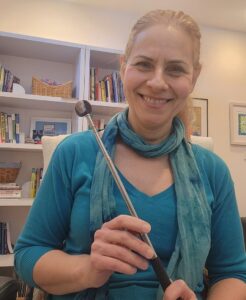
For my demo, I knew Joy would be using Rolling Brainspotting — where the therapist slowly moves a pointer through your visual field and pauses at spots where your nervous system responds. So there are multiple stops along the way.
Once I started talking, I could feel my body responding to what I was saying. Sensations rose in my chest and face. Joy asked me to tune in and asked, “How activated are you around this?”
In Brainspotting therapy we often use something called a SUDS scale (Subjective Units of Distress Scale) — basically a 0–10 rating for distress or activation.
For me, this topic was about a 7.
What Brainspotting Felt Like in My Body
Joy held up her pointer and slowly moved it across the screen at eye level.
She stopped at a spot where she noticed a reflex — a subtle nervous-system response.
Here’s the honest truth: I had no idea what she saw or why she stopped there.
But when she paused… my body knew.
With that first spot, I felt a surge of sensation — a tremulousness — and it was like my body had been waiting for permission to release something. It paired with memories from the recent past and felt connected to the difficult emotions of worry that had been living in me.
I stayed with my gaze on the pointer, letting the sensations build, peak… and then move.
It truly felt like riding a wave.
And then, almost suddenly, the intensity came down.
I don’t know how else to describe it except this: I felt like I was through to the other side of something. Not because I “figured it out,” but because something shifted in my brain and body.
There was an enormous relief — the kind that surprises you because you didn’t even realize how much tension had been there, a relief often sought through a type of therapy.
I could breathe again. I nodded, letting Joy know I was ready to continue.
Joy began moving the pointer again.
She stopped at another place — and again, I didn’t know why that specific spot.
But when she paused, I could feel she had landed on something important.
This time, a vibration-like sensation came up in my ears — something I don’t remember ever experiencing before. No big story attached. No clear thoughts or traumatic memories. Just sensation.
So I stayed with it.
And like another wave, it rose… moved… and passed.
We continued like this for a bit. There were moments when Joy offered gentle cues — letting me know I was doing great, encouraging me to “keep going” and “follow that.”
It wasn’t pushy. It wasn’t performative.
It was steady, supportive, and attuned — the kind of presence that helps your nervous system feel safe enough to process.
What Changed Afterward
By the end of the session, it was like my brain and body knew something a little bit different about my relationship with my mother.
Not just a new thought.
A new feeling in my body.
The best way I can explain Brainspotting Therapy — at least in my experience — is that it felt like moving through waves of emotion until something reorganized itself internally, allowing me to confront painful memories without being overwhelmed.
Like everything got tossed up into the air…
and landed in just the right place.
I often tell my clients: your brain and body know what they need, and you are wired for healing. Brainspotting is one tool that can support that natural capacity — especially when something feels “stuck” beyond words.
Curious About Brainspotting?
If you’re curious about Brainspotting therapy or somatic therapy, reach out. We can talk about the types of therapy you’re navigating and see whether Brainspotting feels like a supportive fit for you.
You don’t have to force healing.
You don’t have to do it perfectly.
You just have to begin — and we can go from there, one steady step at a time.