Whether it’s relief from anxiety, sustained sobriety, freedom from emotional overwhelm, confidence instead of self-doubt, or peace instead of constant stress, these pleas to shift out of the dark places are not just things to work on in therapy, but in fact deeply human desires. You’re awakening to the fact that you don’t want to suffer any longer.
But where do you start?
Back in grad school, I created a steps-focused diagram of a diamond—this helped my brain understand the flow of psychological change. I added language to the diagram and coined it the Permission–Productivity–Positivity Framework, but I didn’t know if it would actually stay relevant the more I learned, experienced, and reflected on this side of the counseling room.
Almost 10 years later, it has held its place as a core component of ‘how to start’ and ‘where does therapy go?’ It can be used on its own, or along with the 12 Steps of Alcoholics Anonymous, with Internal Family Systems, EMDR, the Hakomi Method, and more!
The framework is a three-stage process of emotional healing that moves people from avoidance to authenticity…and because I love alliteration, following the three P’s brings us to the fourth: Proximity to our True Selves.
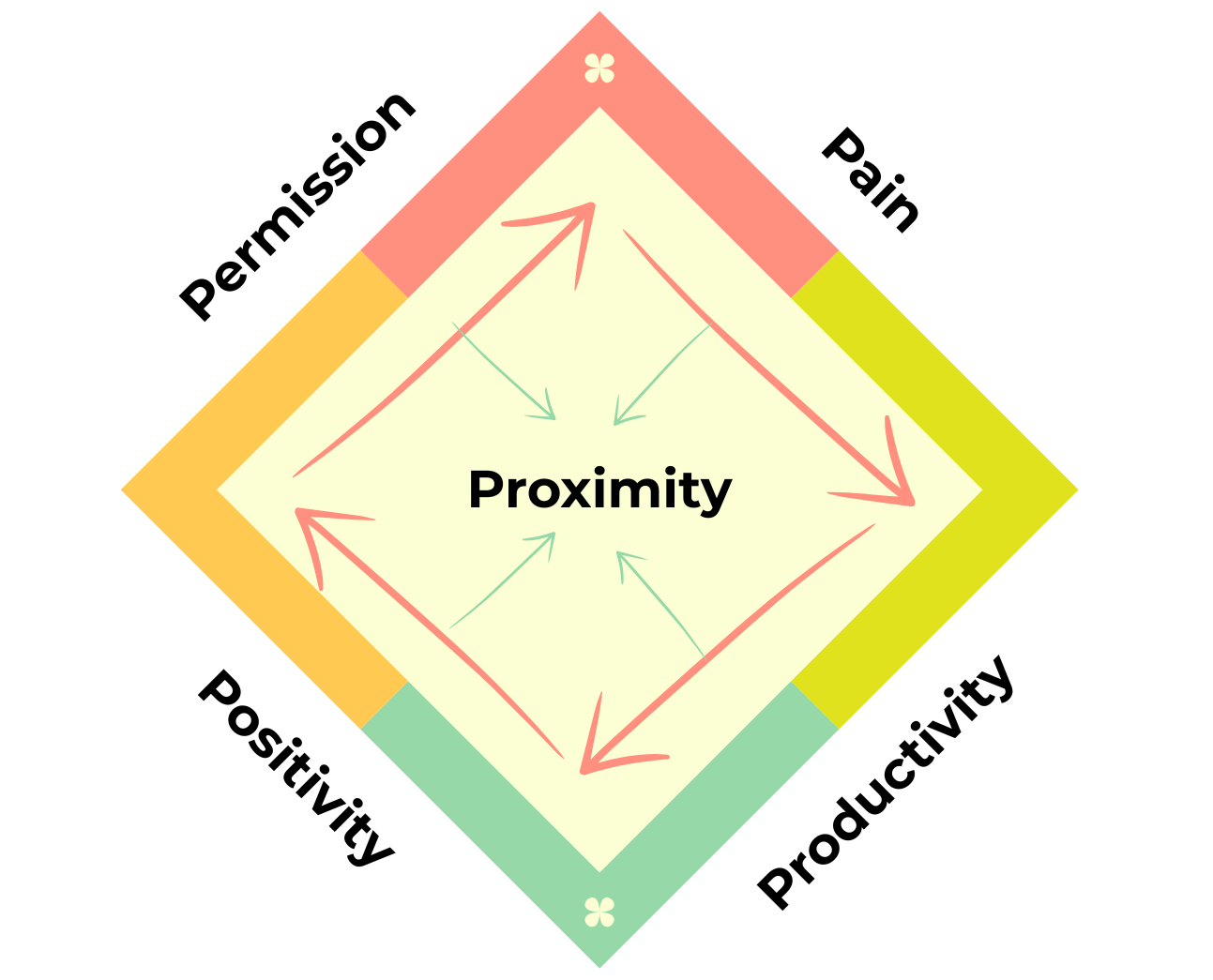
Stage 1: Permission—The Foundation of Emotional Healing
Instead, we learned to push through and stay strong. Maybe we were told to stop being so sensitive to what was happening around us, to just ‘focus on the positive,’ or realized that self-medicating was easier than all the above.
Over time, and without being fully conscious of it, we learned how to suppress our emotions so well so that we could continue showing up to our lives and to what was expected of us. With the advent of mental health being such a topic of conversation these days, now we know that emotional suppression, or that bypass of the human experience, leads to anxiety, depression, burnout, relationship conflicts, emotional numbness, chronic inflammation in the body, and any kind of dis-ease…oftentimes moving the suppression to form actual emotional wounds within us.
In therapy, one of the first goals is creating enough safety to allow emotions to surface without judgment. You get vulnerable, you start talking about things that for years you believed weren’t significant. The therapist can remind you that you are safe and supported, however you alone give yourself the permission to feel.
When we stop fighting our internal experience, the nervous system begins to settle, to regulate. Emotional processing becomes possible, and the way that we store emotional experiences starts to organize and ultimately integrate into our lives as opposed to being a silent part of us. This is the beginning of real emotional healing,
Stage One teaches us that without permission, growth stalls, but with permission, integration begins.
Stage 2: Productivity—Working Through the Pain
Emotional healing is not passive. Once we allow ourselves to feel, or for the emotional experiences to move through our bodies, to express them verbally, or to experientially let them go, we can begin doing meaningful psychological work. This stage often includes identifying patterns rooted in childhood or past relationships, processing trauma, setting healthy boundaries, releasing misplaced guilt and suffering, clarifying values, and making values-aligned life decisions.
This is where productivity lends to a new, vital energy within you. Maybe you start socializing more, maybe you’re sleeping better, or perhaps you’re seeing someone who you’ve known for decades in a whole new light.
When we give ourselves permission to access our pain, true productivity can start blossoming out of the insight created in that space. When pain is acknowledged instead of suppressed, it becomes informative. It may teach us what matters most or where change is needed. Most importantly, we learn that pain is not a threat, but a tool.
Stage 3: Positivity—Authentic, Not Avoidant
When someone has started to process the memories and experiences of anxiety, trauma, addiction, grief, or chronic stress, their positivity feels steady, not fragile. Authentic positivity says: “I have faced my pain. I have forgiven myself. I have compassion for others. I’ve worked through it. And now I can live fully.” This prepares us for any new pain which may find us, or better said, this prepares us to live life on life’s terms.
I aim to guide the client to experience joy without fearing its loss and to navigate conflict without collapsing. I encourage clients to feel the weight of sadness without spiraling or thinking they are broken, and maybe they start choosing love instead of attachment. We are more aware of the internal structures of positivity, no longer only seeking external pleasure, validation, or acknowledgement.
Why This Matters
- Permission
- Productive emotional work
- Authentic positivity
When therapy moves in this order, change is sustainable. Moving toward your True Self becomes clearer.
A Reflection for You
Remember… growth begins with permission!

“Kyara P. Beck, LPCMH is the founder of WellAware Counseling helping clients in Delaware and Pennsylvania. She approaches the healing process through collaboration, grounded in empathy, inner world associations, and practical tools. She believes growth happens through understanding ourselves more deeply and learning how to move forward with intention. She works with individuals and couples who are ready to move beyond coping and toward authentic emotional well-being. Follow her on IG @wellawarede for weekly prompts and integrative wonders.”